
Signs Your Low Voltage Transformer Is Bad
If your landscape lights have gone completely dark, or a whole zone has dimmed or dropped out at once, there's a reasonable chance the transformer is involved — it's the one component that, if it fails, can take out everything downstream of it. A low voltage transformer is bad, or at least suspect, when you see total loss of power to every fixture on a circuit, a transformer that won't stay on even after you reset it, visible scorch marks or a burning smell near the housing, or a faint hum that wasn't there before paired with lights that flicker or cut in and out.
A single dark fixture, on the other hand, usually points somewhere else first — a loose connector, a nicked wire, or a bad bulb. The transformer is the heart of the system, so when it fails, the fault tends to show up as an all-or-nothing problem across a zone rather than one isolated light.
There's also a middle category worth knowing: a transformer that technically still runs but isn't delivering steady power. Lights that seem dimmer across the board than they used to be, or that pulse slightly rather than holding a constant brightness, can mean the transformer is still working but struggling — often a sign it's aging, overloaded, or starting to fail internally rather than having failed outright. That distinction matters because a struggling transformer is worth addressing before it fails completely and takes a whole zone down at once.
How the Transformer Fits Into Your Lighting System
A standard low voltage landscape lighting setup has three main parts: the transformer, the underground wiring, and the fixtures themselves. The transformer steps your home's standard voltage down to a safe low voltage and sends that current out through direct-burial copper wiring — typically 12 AWG or 10 AWG — to the fixtures in the yard. The layout and equipment need to suit the particular installation.
Because every fixture on a zone draws power through the same transformer, it's the single point of failure for that circuit. That's also why, when something goes wrong, diagnosing and repairing low voltage landscape lighting usually starts with checking the transformer first, then the connections, then the wire run itself, in that order — the transformer is the fastest thing to rule in or out, and starting there saves you from digging up wire you didn't need to touch. This guide to diagnosing and repairing low voltage landscape lighting walks through the connections and wire-run steps in more detail if the transformer checks out fine.
It also helps to understand why transformers are sized the way they are in the first place. Every transformer has a wattage capacity printed on the housing, but a well-designed system doesn't load it right up to that number — some headroom is built in on purpose, both for safety margin and so the unit isn't running at its limit every night. A system that was sized correctly when it was installed, with room to spare, tends to put far less day-to-day stress on the transformer than one that was loaded close to its ceiling from the start.
What Causes a Transformer to Fail
Yes, a low voltage transformer can go bad — they aren't designed to last forever, and a few things shorten their life faster than normal wear.
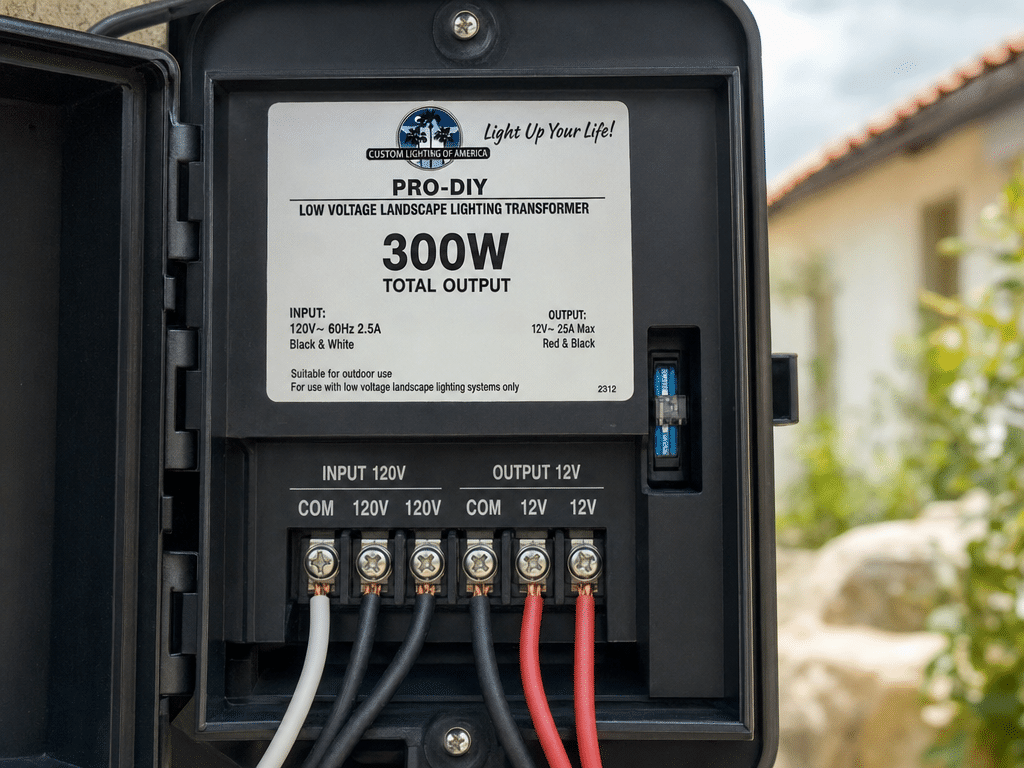
Overloading is one of the most common causes. Every transformer has a wattage capacity printed on the housing, but that number isn't meant to be designed right up to — a system loaded too close to the maximum runs hot and stresses the internal components over time. Moisture intrusion is another frequent cause in outdoor settings, especially if a housing gasket has degraded or the unit wasn't mounted with proper drainage. Power surges, a failed internal fuse, or simple age can also take a transformer out, even on an otherwise well-maintained system.
If your system has been added to over the years — a few extra path lights here, an uplight there — it's worth having someone check what the transformer is actually carrying against its rated capacity. A transformer that was fine for the original design can become undersized once a zone grows past what it was built for.
This is also where correct sizing at the outset pays off. When a system is designed with the transformer's actual load in mind rather than guessed at, it's less likely to run hot, trip unexpectedly, or fail early from being pushed past what it was built to carry. It's one of the reasons getting the original design right matters as much as the fixtures themselves.
Testing the Transformer vs. Everything Else
Before assuming the transformer itself is bad, it's worth ruling out the simpler causes first, since they're more common and far cheaper to fix.
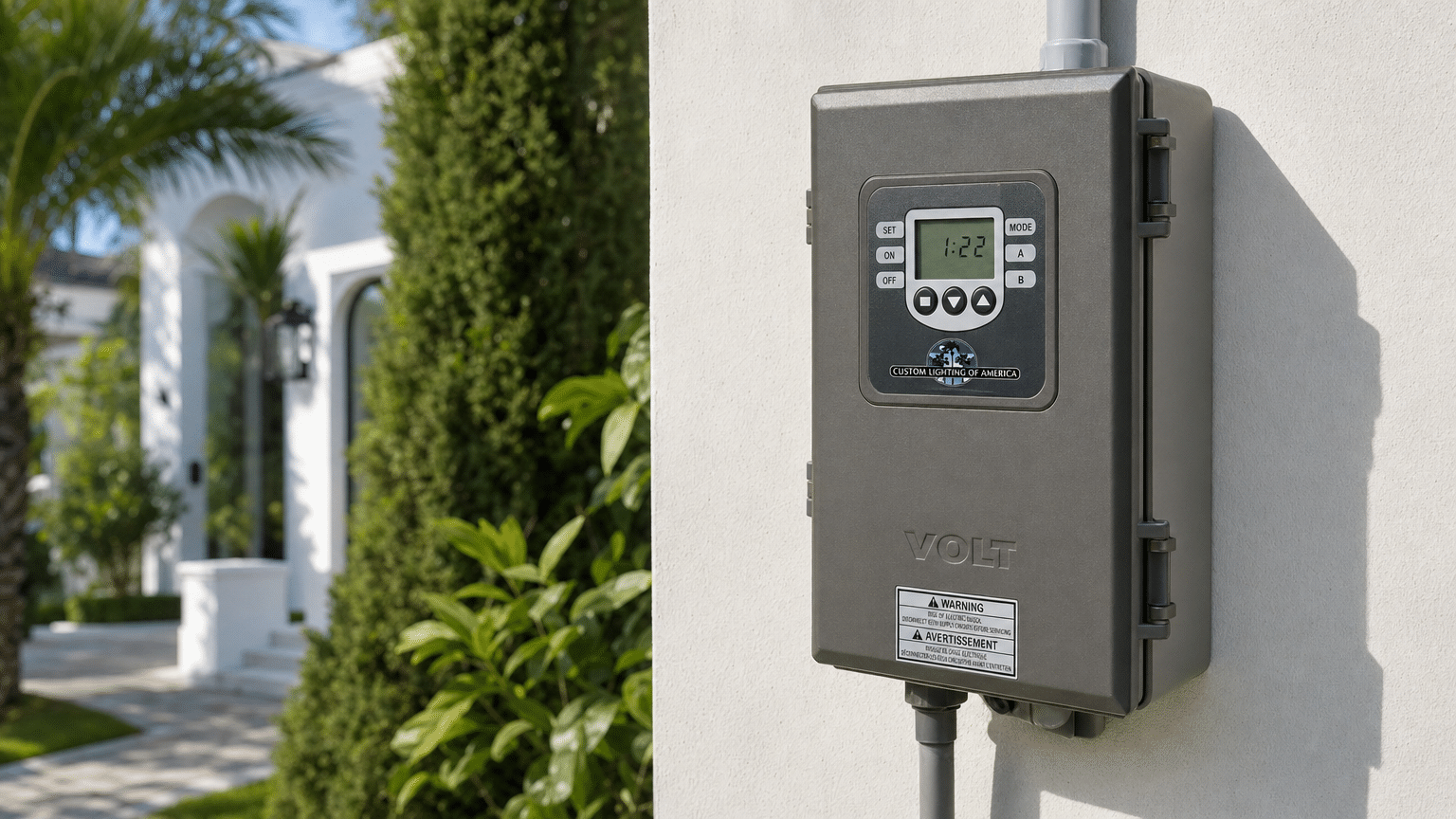
Start with the obvious: is the transformer plugged in, is the outlet it's connected to working, and has the timer or photocell setting been changed or lost power recently (a timer that's drifted can look exactly like a dead transformer from across the yard). If the transformer has a visible display or dial, check that it hasn't been knocked or reset to an odd schedule.
Next, check the connections at the transformer terminals — loose or corroded wire connections at this point can mimic transformer failure, since no power reaches the wire run at all. Corrosion at a terminal often shows up as a greenish or white residue on the copper, and it's worth a visual check before anything else, since it's an easy fix compared to transformer replacement.
If the terminals are tight and clean and the transformer still shows no output, the transformer itself is the more likely culprit, and at that point it's worth having it tested with proper equipment rather than guessing further. Reading voltage accurately at the transformer terminals and at a fixture further down the run can confirm whether the transformer is putting out power at all, or whether it's putting out power but losing too much of it before it reaches the far end of the zone — two different problems with two different fixes. That kind of testing isn't something to do casually around outdoor wiring, particularly if the housing or connections have been exposed to moisture.
Resetting a Tripped Transformer
Many outdoor transformers are connected to a GFCI-protected outlet or circuit, and a tripped GFCI is one of the most common reasons a system appears completely dead. If your transformer has stopped working, check the GFCI outlet it's plugged into (or the one upstream of it) for a tripped reset button before assuming the transformer has failed. Some transformers also have their own internal reset or circuit breaker built into the housing, separate from the GFCI outlet it plugs into — it's worth checking both, since either one tripping on its own will shut the whole system down.
If resetting it restores power and the system runs fine afterward, the transformer likely isn't the problem — something else, like a short in the wire run, tripped the protection. If it trips again shortly after resetting, that repeat trip is itself a warning sign worth paying attention to, rather than something to keep resetting indefinitely. A GFCI or breaker that trips repeatedly is doing its job by protecting the circuit; the underlying fault, whether it's in the transformer or further out in the wiring, still needs to be found.
When to Call a Professional
If you've checked the outlet, the timer settings, and the connections at the transformer and you're still getting no power, or the unit keeps tripping after a reset, that's the point to bring in someone who works on these systems regularly. Testing a transformer's actual output, and tracing a fault further down a buried wire run, both call for equipment and experience most homeowners don't use often enough to justify buying.
CLA Lighting provides low-voltage landscape lighting design, installation, upgrades, repair and service in South Florida. If the transformer, wiring or connections need a professional diagnosis, ask the team about the appropriate next step for your system.
Questions and answers
What are the early warning signs of transformer failure?
Watch for a zone that's dimmer than it used to be, lights that flicker intermittently rather than staying steady, a faint hum or warmth from the transformer housing, or a GFCI that trips more often than it used to. Any of these can show up before a transformer fails completely.
Do you need an electrician for a landscape lighting transformer problem?
It depends on what the problem turns out to be. Checking a GFCI, resetting a breaker, or inspecting terminal connections is often within reach for a homeowner, but confirming whether a transformer is actually bad, or tracing a fault deeper into the wire run, calls for someone who works on these low voltage systems regularly. CLA Lighting offers landscape lighting repair and service in South Florida. Ask the team about the appropriate next step for your particular installation.
Contact CLA Lighting to discuss its landscape lighting repair and service options for your installation.