
There's No Single Average Cost to Install Landscape Lighting
The average cost to install landscape lighting depends on too many variables to boil down to one number — how many fixtures a property needs, how far the wire has to run from the transformer, what the fixtures are made of, and whether the job is a simple path-lighting layout or a full custom design. A small front walkway with a handful of path lights is a different project from lighting an estate's facade, specimen trees, water feature, and driveway gate.
We design and install low-voltage landscape lighting systems across South Florida, and every quote we give is built around the specific property — not a flat rate. What we can do here is walk through the factors that actually move the price up or down, so you know what questions to ask and what to expect when you get a quote.
It also helps to know that two properties with the same square footage can land in very different places on cost. A single-story home with a straightforward foundation planting bed is a much shorter wiring job than a property with mature oaks spread across a deep lot, a pool deck, and a gated entry — even if both homes are roughly the same size. Square footage alone is a weak predictor; layout and the number of features worth lighting matter more.
What Affects the Average Cost to Install Landscape Lighting
A few things consistently drive the average cost to install landscape lighting on any given property:
Fixture count and type. Uplights for trees, path lights for walkways, step lights, and spotlights for architectural features all cost differently, and a layout that mixes several types costs more than one that uses a single fixture style throughout.
Wire runs and voltage drop. Low-voltage systems lose voltage over distance, so longer runs or larger properties sometimes need heavier-gauge wire or additional transformers to keep fixtures at the back of the run as bright as the ones near the house. We've written in detail about how far low-voltage wire can run before voltage drop becomes a problem, which is worth understanding before you compare quotes — a bid that ignores voltage drop can look cheaper and perform worse.
Fixture material. Fixtures are made in different materials, and material affects both upfront price and how the fixture holds up outdoors over time. We've laid out why brass and copper outdoor fixtures tend to outlast cheaper alternatives if that's part of what you're weighing.
Design complexity. A landscape lighting plan that layers uplighting, path lighting, and accent lighting to highlight specific features of a property takes more design time than a straight row of path lights — and that design work is part of what you're paying for with a professional system.
Transformer capacity and zoning. Every low-voltage system runs off one or more transformers, and the transformer has to be sized for the total wattage it's feeding plus some headroom for future additions. A property that needs two or three zones — front yard on one schedule, backyard entertaining area on another — generally costs more than a single-zone layout, simply because it involves more transformer capacity, more wire runs, and more planning to keep each zone balanced.
Site conditions and access. Trenching through an established planting bed with mature root systems takes longer than running wire through open soil, and a system installed alongside new landscaping is often more efficient than retrofitting one into beds, sod, and hardscape that are already in place. None of this changes what the lighting itself costs, but it does affect the labor side of a quote.
DIY vs. Professional Landscape Lighting Installation
Installing landscape lighting yourself with a retail kit is possible, but it shifts the design and labor onto you — choosing fixture types, running wire to the right lengths, sizing the transformer, and compensating for voltage drop across the property. CLA Lighting designs and installs full landscape lighting systems; we don't sell do-it-yourself kits.
What a professionally designed and installed system includes is site-specific design, correctly sized wire for the actual run lengths on your property, and installation by people who do this daily. A retail kit will generally cost less upfront than a professionally designed system, since you're providing the labor and making the layout decisions yourself. Which route makes sense depends on the property, your comfort with the work, and how custom the lighting plan needs to be.
The practical gap shows up most on larger or more complex properties. A short run of path lights along a small walkway is a reasonable weekend project for a comfortable DIYer. But once a layout needs to balance several zones, light trees of different heights without glare, or work around a pool, dock, or gate, the number of decisions — fixture aiming angle, beam spread, wire gauge for each run, where the transformer sits relative to the farthest fixture — grows quickly, and getting any one of them wrong usually means uneven lighting or a fixture that fails early rather than a system that looks designed.
Do You Need an Electrician to Install Landscape Lighting?
Low-voltage landscape lighting runs on 12-volt circuits stepped down by a transformer — a different regulatory category than line-voltage household wiring — but installers are still required to hold a Low Voltage License to perform this work in Florida. CLA Lighting is licensed and insured for landscape lighting design and installation, which matters both for code compliance and for protecting the homeowner if something goes wrong during the job.
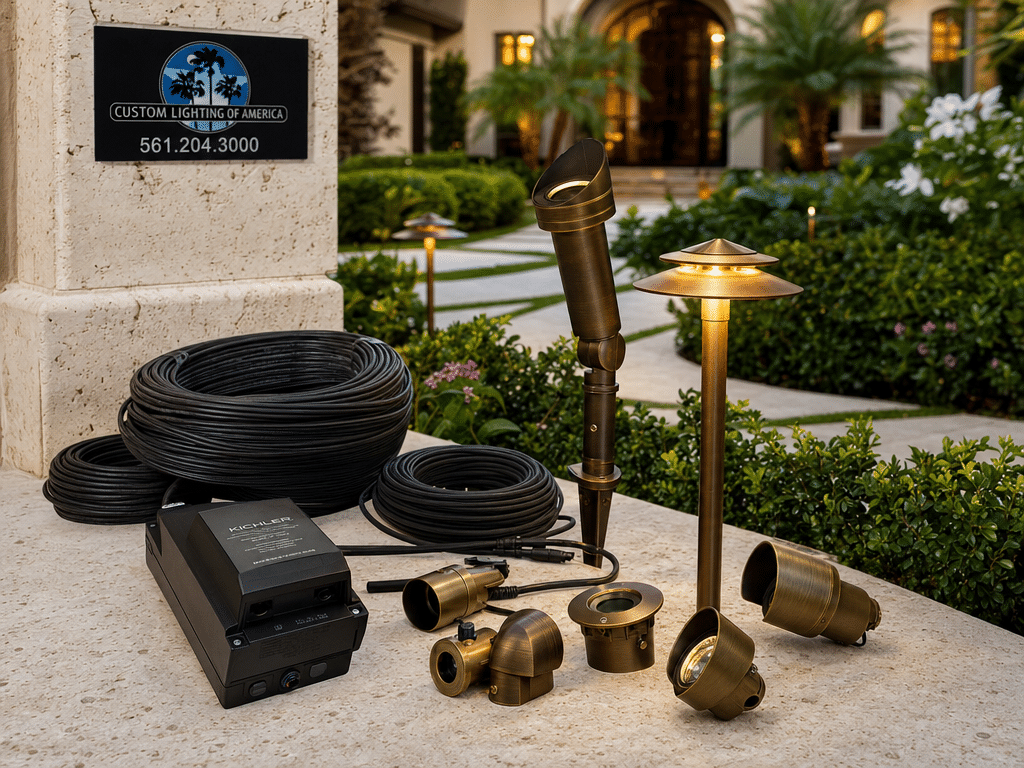
The license requirement is worth understanding rather than skipping past. Even though the voltage involved is far lower than household current, the work still touches the home's electrical system at the transformer connection, and it involves outdoor wiring that has to be installed correctly to avoid shorts, water intrusion, or premature fixture failure. Asking a prospective installer whether they hold a Low Voltage License — and asking to see proof of insurance — is a reasonable question to put to anyone bidding the work, not just us.
Big-Box Store Installs vs. a Custom-Designed System
Big-box retailers sometimes offer installation for individual light fixtures, which is a different scope of work than a landscape lighting system. Installing one fixture is a fixture-mounting job; designing and wiring a layout that covers an entire property — balancing fixture placement, wire runs, transformer capacity, and voltage drop across the whole system — is a design and electrical job that requires a Low Voltage License. We don't have pricing information on what big-box retailers charge, so we won't guess at a number, but the scope difference is the thing worth understanding before comparing two quotes that aren't actually for the same work.
It's worth asking a direct question when you're comparing bids: does this quote include a design — a plan for where each fixture goes and why — or is it just a per-fixture installation charge? A quote built around a design accounts for things like aiming trees so the light reads naturally rather than flooding the canopy, spacing path lights for even coverage instead of hot spots, and keeping wire runs within a length that won't cause voltage drop at the far end. A per-fixture install price generally doesn't include any of that planning.
Repairs, Upgrades and the Cost of Owning a System Long-Term
The cost to install landscape lighting is only part of the picture — systems need occasional troubleshooting and upgrades over the years. We handle landscape lighting repair and troubleshooting for existing systems, including ones we didn't originally install, and we also do upgrades when a homeowner wants to expand a layout, switch to LED, or replace aging fixtures. Budgeting for occasional service is a more realistic way to think about long-term cost than treating installation as a one-time expense with nothing after it.
The parts of a system that typically need attention over time are the connections and the fixtures themselves — wire connectors exposed to moisture and soil can corrode, fixture housings weather, and lamps or LED modules eventually reach the end of their life. None of that means a system is poorly installed; it's the normal wear of equipment that lives outdoors year-round. What it does mean is that an occasional check-up, rather than waiting until several fixtures go dark at once, tends to keep a system looking the way it did on day one for longer.
Getting an Accurate Quote for Your Property
Because the average cost to install landscape lighting varies so much by property, the only way to get a number that actually means something is a design conversation specific to your home. We work with upscale homeowners, HOAs and COAs across Palm Beach, Palm Beach Gardens, Jupiter, Jupiter Island, Palm Beach County, Martin County, St. Lucie County, and Broward County, and we've been designing and installing systems in South Florida since 2002.
A site visit for a quote typically means walking the property — ideally at or near dusk, since that's when you can actually see how trees, architecture, and hardscape read in the dark — and talking through which features matter most to you: the entry, a specimen tree, a pool area, or the whole perimeter. From there, fixture count, wire routing, and zoning fall out of the actual layout rather than a guess.
If you want a quote built around your actual property rather than a generic estimate, the Landscape Lighting Palm Beach page is the place to start — it covers our design and installation service for the Palm Beach area.
Questions and answers
Do you need an electrician to install landscape lighting?
Low-voltage landscape lighting is wired differently than household line-voltage circuits, but Florida still requires installers to hold a Low Voltage License to do this work. CLA Lighting is licensed and insured for landscape lighting design and installation in Florida.
Is a DIY landscape lighting kit cheaper than professional installation?
A retail DIY kit generally costs less upfront, since you're providing the labor and making the design decisions yourself. CLA Lighting designs and installs full systems and does not offer DIY kits — a professionally designed and installed system adds site-specific design, correctly sized wiring, and installation labor on top of the materials.
For a quote built around your property's actual layout, visit the Landscape Lighting Palm Beach page or call to set up a design conversation with CLA Lighting.