What You're Actually Looking For When You Search This
"Landscape lighting learning center" usually means one of two things. Either you want to understand how good outdoor lighting design actually works, so you can make smart decisions about your own yard. Or you're hoping to find a program that trains and certifies people to work in the trade.
CLA Lighting isn't a training school. We're a design-and-installation company that's worked across South Florida — from Palm Beach to Broward County — since 2002, and we're licensed and insured. What we do have is years of hands-on experience with the exact questions homeowners and HOA boards ask us, and we've turned a lot of that into guides on our own site. Think of this page as the front door to that library, plus a straight answer on the certification question.
If You Want to Learn Landscape Lighting Design
Good outdoor lighting design starts on the property, not in a catalog. It's about deciding what to highlight — a specimen tree, an entry, a facade — and what to leave in shadow, and how the light layers across the whole space so nothing looks flat or blown out. That's a design skill more than a shopping list, and it's why a walk-through with someone who does this daily tends to catch things a plan drawn from a distance would miss.

For upscale homes and HOA or COA properties, that walk-through is where our design consultants start every project, looking at the architecture and the landscape together before recommending a single fixture.
Color Temperature and Lumens: The Technical Groundwork
Two terms come up in almost every design conversation: color temperature, measured in Kelvins, and brightness, measured in lumens. Get the color temperature wrong and a well-placed fixture can still look cold and clinical against a warm stucco facade, or too amber next to cool stone. Get the lumen count wrong and you either wash out the plant material or leave it too dim to matter.
We've written a full breakdown of how Kelvins and lumens work together in an outdoor layout, including how to choose between warmer and cooler light for different materials and plantings, on our landscape lighting color temperature guide. That's the place to go deep on the technical side, so we won't repeat it here.
Tutorials: Installing, Diagnosing, and Repairing a System
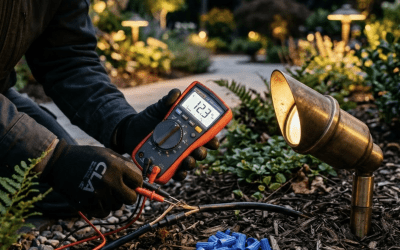
If a fixture stops working, flickers, or changes color unexpectedly, the fix is usually electrical rather than mysterious — a bad splice, voltage drop, or a failed transformer connection. We've laid out the diagnostic steps a homeowner can walk through, and where to stop and call a professional, in our guide to diagnosing and repairing low voltage lighting.
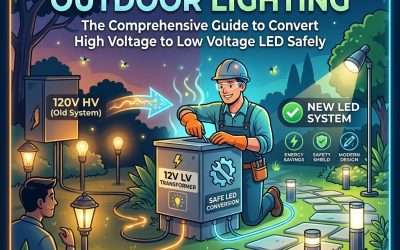
If your property still has an older high-voltage outdoor lighting system and you're weighing whether to convert it, our guide to retrofitting high voltage systems to low voltage LED covers what that conversion actually involves.
Why Fixture Material Matters as Much as the Bulb
No real education on landscape lighting is complete without talking about what the fixture is made of, since that decides how long the system lasts in Florida's climate. Brass and copper both hold up well outdoors and develop a patina over time rather than corroding the way cheaper metals do. We break down those differences, and why we favor brass and copper for the properties we work on, on our brass and copper fixtures page.
Certification and Training in Lighting Control: What's Actually Out There
If you're asking this because you want to get certified in landscape lighting as a career, you're looking for the professional side of the industry — manufacturer training programs and trade associations exist for installers and designers entering the field. That's not something CLA Lighting offers to the public; our focus is design and installation for homeowners and HOA or COA clients, not training other contractors.
If instead you're a homeowner wondering how to learn to run your own lighting control setup, that's usually best learned on your own property rather than from a general course. Every yard's wiring, transformer, and control panel is different, so the person who installs your system is the one who should walk you through operating it — not a generic tutorial written for someone else's yard.
Questions and answers
How can I get certified in landscape lighting?
Certification programs for the trade typically come through manufacturers or industry associations, aimed at installers and designers rather than homeowners. CLA Lighting doesn't run a certification program — we design and install systems for South Florida properties. If you're a homeowner, what you need isn't a certification, it's a licensed, insured designer who will walk your property with you.
Can you provide a tutorial for installing landscape lighting?
We don't publish a start-to-finish install tutorial, because a proper install depends heavily on your property's electrical layout and voltage load — the kind of thing that's hard to generalize safely. What we do have is a detailed guide to diagnosing and repairing an existing system, and a guide to retrofitting an older high-voltage system to low voltage LED, both linked above.
Where can I find training in lighting control?
Professional-grade training on a control system typically comes from the manufacturer of that specific product. For your own property, the most useful training is a walkthrough from whoever installs your system, since the panel or app you'll use is tied to your particular layout.
Where can I learn lighting design?
Start with the design principles — layering light, choosing focal points, matching color temperature to your materials — covered across the guides linked in this article. For a plan specific to your own property, a design consultation with our team is the fastest way to get there.
Request a free design consultation or call 561.204.3000 to have one of our designers walk your Palm Beach County property with you.