
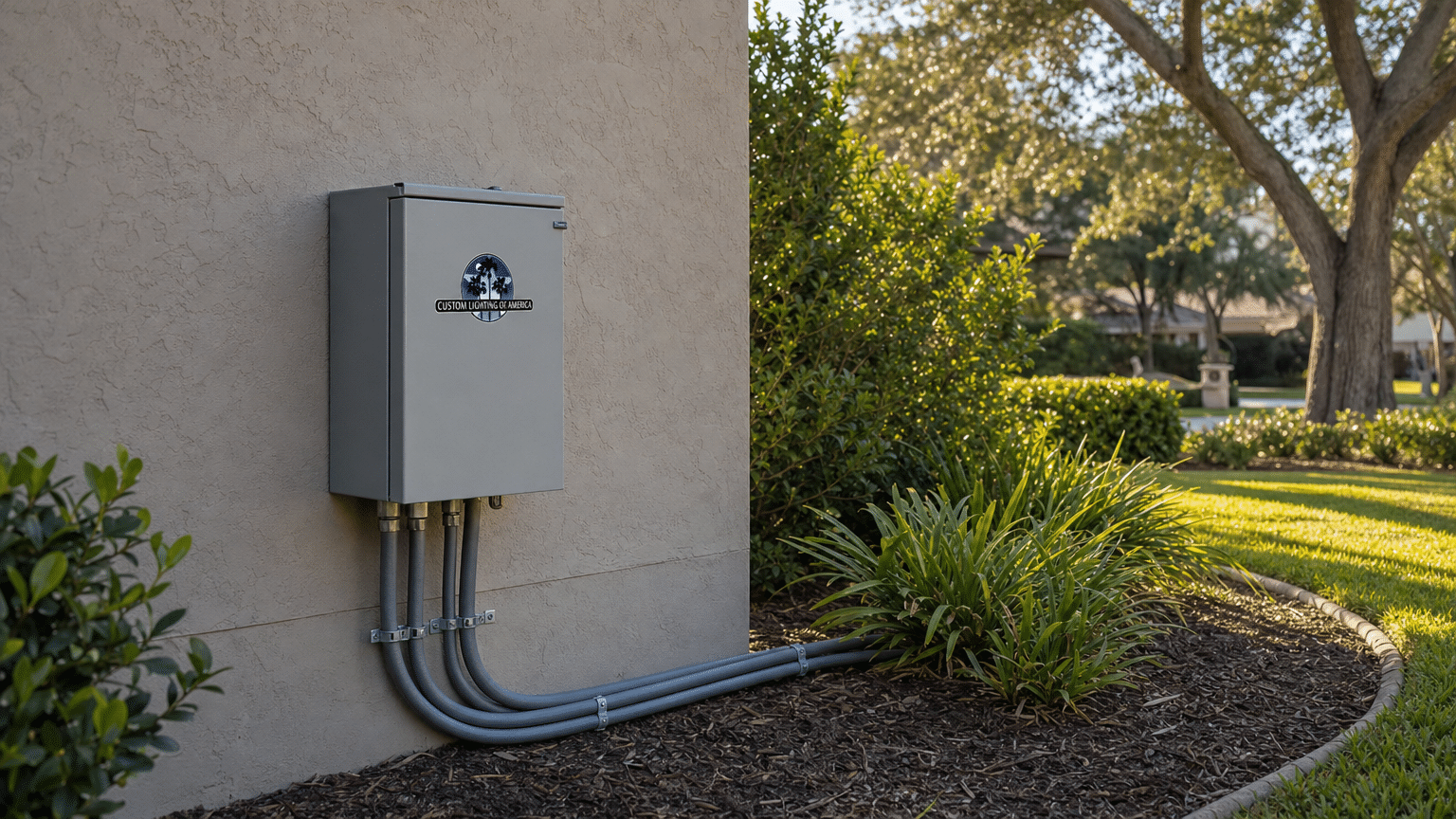

The Short Answer: It Depends on Voltage Drop, Not Just Distance
There's no single maximum distance that applies to every low-voltage landscape lighting run. The real limit is voltage drop — the gradual loss of voltage as electricity travels through wire. A fixture 100 feet from the transformer on a thick, lightly loaded wire can perform fine, while a fixture only 60 feet away on thin wire carrying a heavy load can be noticeably dim. So the honest answer is: it depends on the wire gauge, the transformer's output, and how much total wattage is connected on that run.
That's not a dodge — it's genuinely how the physics works. Anyone who tells you a flat number like "never run more than 100 feet" is giving you a rule of thumb that happens to be true in some yards and wrong in others. The number that actually matters is the voltage the fixture at the end of the run receives, not the number of feet of cable between it and the transformer.
Why Voltage Drop Happens
Low-voltage systems typically run at 12 volts. As current travels down a copper wire, resistance in the wire causes some voltage to be lost before it reaches the fixture. The longer the wire, the more resistance it has, and the more voltage is lost along the way. The more fixtures (and wattage) pulling current through that same wire, the faster the drop accumulates. By the time electricity reaches a fixture at the far end of a long run, it may be receiving significantly less than 12 volts — even though the transformer is putting out full voltage at the source.
This is also why voltage drop isn't a problem you can eyeball from a spec sheet. It compounds. Add one more fixture to a run, and you're not just adding that fixture's wattage — you're adding draw to every foot of wire upstream of it. Two identical-looking runs can behave completely differently depending on where the fixtures sit along the line and how much each one pulls.
What Actually Determines How Far a Run Can Go
Three things interact to set the practical limit on any given run: wire gauge, transformer output, and total connected load. Thicker wire (a lower gauge number, like 10-gauge versus 14-gauge) has less resistance and carries voltage further with less loss. A transformer with multi-tap settings (commonly adjustable in small increments above 12 volts) can push slightly higher voltage out to compensate for drop over a longer run. And the more fixtures — or the higher their combined wattage — on a single run, the shorter the distance that run can reasonably go before the far fixtures start to suffer.
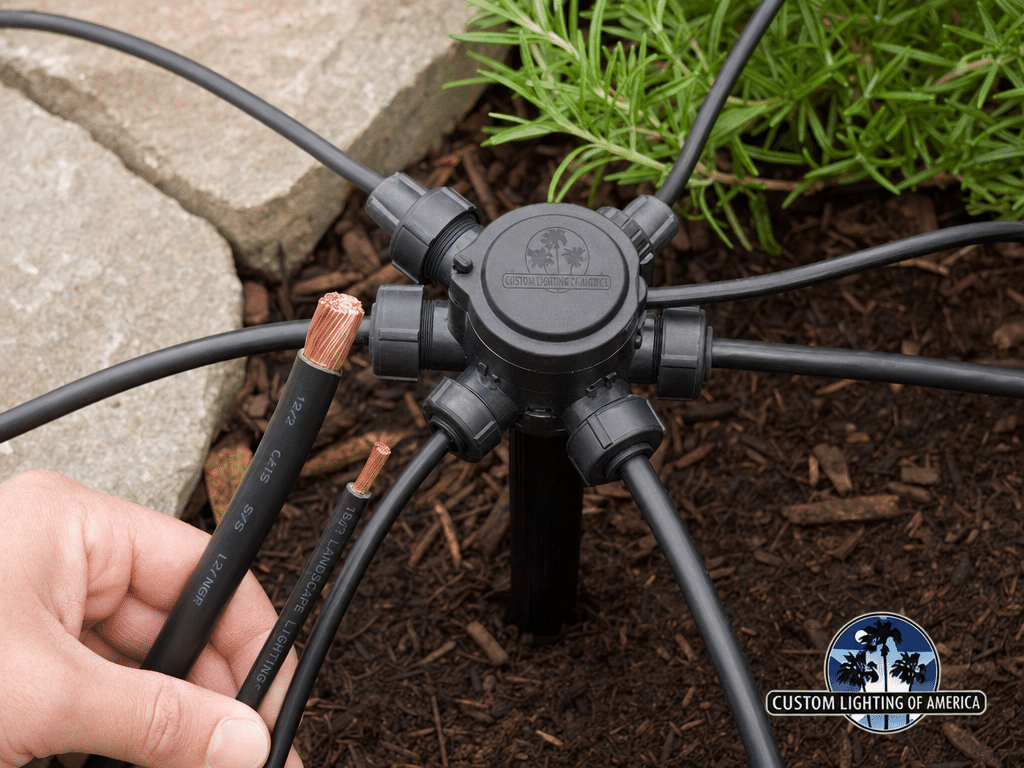
Wiring method matters too. A daisy-chain run, where fixtures are wired one after another in a line, accumulates voltage drop at every connection point. A home-run or hub approach, where multiple shorter cable runs branch out from a central junction closer to the transformer, keeps each individual run shorter and reduces the cumulative drop any single fixture experiences. For larger or more spread-out yards, this is usually the more reliable approach.
None of these three factors can be set in isolation. Bump up the wattage on a run and the wire gauge that worked fine before may no longer be adequate. Switch to a home-run layout and you may be able to use a lighter gauge than a daisy chain would have required over the same distance. This is exactly the kind of interdependent math that's easy to get approximately right and surprisingly easy to get specifically wrong.
Signs a Run Is Already Too Long
On an existing system, voltage drop shows up as a pattern, not a single failure. Fixtures near the transformer look normal, while ones further down the line look dimmer or slightly off-color — often warmer or yellower than the rest. Lights at the end of a run may flicker, especially as the system warms up or as other fixtures draw current. Bulbs at the far end can also burn out faster than ones closer to the source, since inconsistent voltage stresses the fixture over time. If that pattern sounds familiar, it's worth reading our guide to diagnosing and repairing low voltage landscape lighting before assuming a bulb or fixture has simply failed.
It's also worth checking the pattern against the layout, not just the symptom. If the dim fixtures are the ones furthest from the transformer along a single continuous wire, voltage drop is the likely cause. If dim or flickering fixtures are scattered without any relationship to distance, the cause is more likely a bad connection, corrosion, or a failing component — a different problem with a different fix.
Why the Math Gets Complicated Fast
On paper, a voltage drop calculation looks simple: wire gauge, distance, and total wattage plug into a formula and tell you the expected drop. In practice, a real yard rarely cooperates with a simple formula. Fixtures get added after the fact. Runs get rerouted around a tree root or a hardscape feature, adding length that wasn't in the original plan. A client decides they want two more uplights on a specimen palm partway through installation, and suddenly the wattage on that run — and the gauge needed to support it — has changed.
This is exactly why voltage drop planning works better as part of a professional design process than as a one-time calculation someone runs and sets aside. It's not that the math is hard to do once — it's that it has to be redone every time a fixture is added or a run gets rerouted, and that's easy to lose track of without someone tracking it as part of the job. A run that was fine for four path lights isn't automatically fine for six, and a wire gauge sized for 60 feet in a straight line isn't necessarily sized correctly once the actual trench adds another 20 feet to route around a planting bed. Getting this right consistently — across every run, every time a fixture is added — is one of the reasons working with a professional landscape lighting company, rather than guessing at a one-off calculation, pays off over the life of a system.
Planning a Run Instead of Guessing at One
Because gauge, load, and transformer output all interact, there isn't a rule of thumb that holds up across different yards. A run that works well for six path lights won't necessarily work for the same length of wire feeding four uplights on mature trees, because the wattage and draw are different. The more reliable approach is to calculate the expected voltage drop for the specific layout — fixture count, wattage, wire gauge, and distance — before anything goes in the ground, rather than finding out after installation that the last two fixtures are dim.
This is really a design question as much as an electrical one, since the layout of the yard determines how the wire needs to be routed and split. If you're planning a new system or adding fixtures to an existing one, our landscape lighting design process accounts for wire runs and voltage drop as part of the layout, rather than treating them as an afterthought — because the calculation isn't something you do once and set aside, it's something that has to hold up as the design evolves and fixtures get added over the life of the system.
Questions and answers
Can I just use thicker wire to run further?
Thicker wire reduces resistance and helps, but it's not the only variable. Total wattage on the run and the transformer's output still matter. A thicker wire extends how far you can go, but it doesn't remove the limit entirely — heavy loads can still cause noticeable drop even on heavier-gauge cable.
Does splitting a run into shorter branches really make a difference?
Yes. Running several shorter cables out from a central point, instead of one long daisy-chained line, keeps the voltage drop on each branch lower because the distance and connection points per branch are reduced. This is usually the more practical fix for larger yards where fixtures are spread out.
If you're planning fixture placement and want the wire runs sized correctly from the start, reach out to CLA Lighting about a landscape lighting design for your yard.


